Pune Metro Impact on Property Prices: Which Areas Will Gain the Most by 2028?
By The 24K Lifestyle Team | Last Updated: August 26, 2026
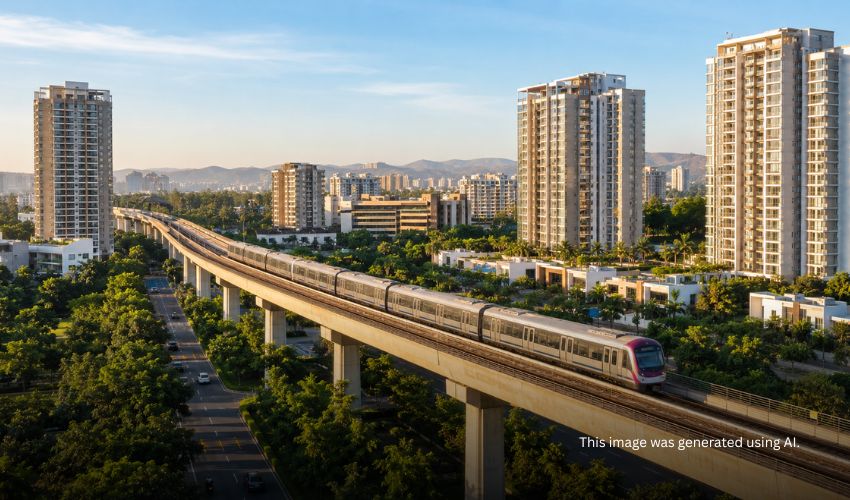

Table of Content
Pune Metro is no longer a blueprint pinned to a government office wall. Two lines are running. A third is weeks from launch. And the effect on property prices across the city is no longer speculative. It is measurable.
Line 1, the Purple Line, runs 16.6 km from Pimpri-Chinchwad to Swargate through 14 stations. It has been operational since March 2022 and serves the PCMC industrial belt, Dapodi, Khadki, Shivajinagar, and the central business district. Extensions to Bhakti Shakti Chowk (north) and Katraj (south) are approved, with completion expected between 2027 and 2029.
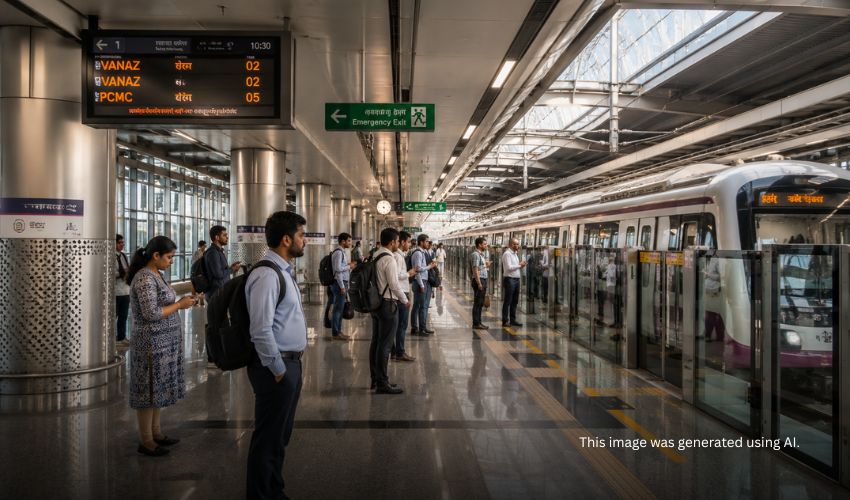
Line 2, the Aqua Line, connects Vanaz to Ramwadi across 14.66 km and 16 stations. It covers Kothrud, Nal Stop, the university area, Pune Station, Yerawada, and Ramwadi. This line handles the east-west commute that previously choked traffic through Karve Road and Tilak Road.
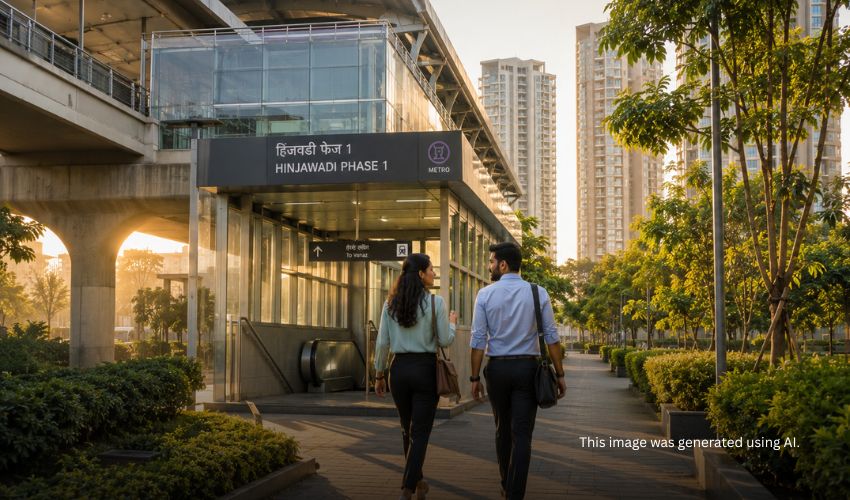
Line 3, the Pink Line, is the one that changes the game for west Pune real estate. Stretching 23.2 km from Hinjewadi to Shivajinagar through 23 stations, it connects the IT epicentre of Hinjewadi directly to the residential corridors of Balewadi, Baner, and Aundh. Construction is at 94.58% completion as of early 2026, with trial runs underway and commercial operations expected within months.
What makes Line 3 different from the other two is its route. It does not just connect residential areas to commercial hubs. It runs through the most expensive residential real estate in Pune, linking stations at Baner, Baner Gaon, Balewadi Phata, and Balewadi Stadium to the Hinjewadi IT Park where over 800,000 professionals work daily.
The numbers speak for themselves. Combined ridership across Lines 1 and 2 crossed 10 crore cumulative passengers by October 2025, with daily averages touching 2.21 lakh riders. Revenue for FY2025-26 reached Rs 110.97 crore. This is not a vanity project. It is a transit system that people are actually using.
What Metro Did to Property Prices in Delhi, Bengaluru, and Mumbai
Before projecting what Pune Metro will do to local prices, it is worth looking at what metro systems have already done to property markets in other Indian cities. The pattern is remarkably consistent.
Delhi NCR saw the most dramatic impact. According to a Knight Frank study, residential properties within 500 metres of Delhi Metro stations appreciated between 80% and 102% over a ten-year period post-commissioning. Dwarka, which was considered a peripheral suburb before the metro arrived, saw average rates climb from Rs 3,500 per sq ft to over Rs 8,000 per sq ft within eight years of metro operations beginning.
Bengaluru Namma Metro delivered similar results on a compressed timeline. Indiranagar and MG Road, already premium addresses, saw an additional 15-20% premium emerge for properties within walking distance of metro stations. The more telling story was in areas like Nagasandra and Peenya, where the metro turned formerly overlooked industrial pockets into legitimate residential options with price gains of 40-60%.
Mumbai Metro, despite covering only 11.4 km in its first phase, generated a 20-25% price premium along the Versova-Andheri-Ghatkopar corridor within five years of launch. The premium was highest at interchange stations where metro lines connected to suburban rail, effectively doubling the transit network accessible from a single location.
The lesson from all three cities is the same: the metro premium is not imaginary. It shows up in transaction data, not just asking prices. And it shows up strongest in areas where the metro solved a genuine commute pain point, not just added a transport option alongside existing ones.
Pune Metro Line 3 checks that box emphatically. The Hinjewadi-Shivajinagar corridor has been one of the worst bottlenecks in Indian urban planning for a decade. On a bad day, the 20 km drive from Hinjewadi Phase 3 to Shivajinagar takes 90 minutes. The metro will do it in 35.
Pimple Nilakh Station Impact: What It Means for 24K Manor, Opula, and Atria
Pimple Nilakh is positioned to be one of the biggest beneficiaries of Pune Metro Line 3. The area sits between the Balewadi and Baner stations, with the Pimple Saudagar station also within accessible range. For residents of 24K Manor, 24K Opula, and 24K Atria, this means metro connectivity within a 1.5-2 km radius of their doorstep.
The current price trajectory in Pimple Nilakh already reflects metro anticipation. Average rates have moved from Rs 7,500-8,500 per sq ft in 2022 to Rs 9,500-11,500 per sq ft in early 2026, a jump of roughly 25-30%. Brokers working the area attribute at least a third of that movement to metro-driven demand, with the remainder split between organic IT sector growth and limited new land availability.
24K Manor, with its 3 BHK and 4 BHK configurations across three MAHARERA-registered towers (P52100052151, P52100054048, P52100079296), sits in a sweet spot. It is close enough to benefit from station proximity premiums but positioned in an established residential pocket with schools, hospitals, and retail already in place. That combination matters because metro impact on property prices is always stronger in areas with existing social infrastructure than in greenfield zones.
Opula and Atria, also in Pimple Nilakh, benefit from the same locational dynamics. The entire micro-market is being repriced as commuters who previously avoided Pimple Nilakh due to road congestion now see it as a viable base for daily commutes to Hinjewadi, Shivajinagar, and beyond.
The Pimple Nilakh-to-Hinjewadi IT Park commute, which currently takes 30-45 minutes by road depending on time of day, will drop to under 15 minutes by metro. For dual-income households where one partner works in Hinjewadi and the other in Aundh or the city centre, this changes the housing calculus entirely.
: Why This Corridor Leads the Pack
Baner and Balewadi have spent the last decade becoming Pune's most sought-after residential addresses. Rates have climbed from Rs 6,000-7,000 per sq ft in 2015 to Rs 11,000-14,000 per sq ft in 2026. The question is whether there is further upside. Metro Line 3 makes a strong case that there is.
Four Line 3 stations directly serve this corridor: Baner, Baner Gaon, Balewadi Phata, and Balewadi Stadium. That density of coverage means that virtually every residential project in Baner and Balewadi will be within a 10-15 minute walk of a metro station. In transit planning terms, this is textbook transit-oriented development territory.
24K Altura, located behind Solitaire World off the Mumbai-Bengaluru Highway in Baner (MAHARERA: P52100051316), is among the projects positioned to benefit most directly. The Balewadi Stadium station sits within comfortable distance, putting the Hinjewadi IT Park at one end of the line and Shivajinagar at the other within a single metro ride.
Year-on-year appreciation in Baner has been running at 13.8% according to multiple property portals. But the more interesting figure is the station proximity premium. Properties within 500 metres of announced Line 3 station locations are already commanding 8-12% more than comparable units 1.5 km away. This premium is likely to widen once commercial operations begin and commute time savings become tangible rather than theoretical.
For investors evaluating Baner-Balewadi, the value thesis is straightforward: the metro does not just improve connectivity. It removes the primary objection that has historically capped price growth in this area, which is the Hinjewadi commute bottleneck. With that constraint lifted, Baner and Balewadi price ceilings move to a new equilibrium.
Hinjewadi Extension and the Life Republic Belt: 24K Espada's Position
Hinjewadi has always had a split personality in Pune's property market. Phase 1 is dense and commercially mature. Phase 2 is the employment hub with the highest office space concentration. Phase 3, extending into the Mahalunge-Maan-Punawale belt, is where most of the residential growth is happening.
24K Espada sits in this growth zone, positioned within the Life Republic master-planned township area in Hinjewadi-Punawale. It offers 4 BHK and 5 BHK luxury residences, targeting the senior IT professional and business owner segment that wants space and privacy without leaving the Hinjewadi ecosystem.
Metro Line 3 terminates at the Hinjewadi depot station, with the Megapolis Circle station serving the broader area. For Espada residents, the metro effectively eliminates the need to drive into the congested Phase 1-2 office zone. A metro ride from the Hinjewadi end to Shivajinagar takes 35 minutes flat, a commute that by road can stretch past 90 minutes during peak hours.
The Hinjewadi-Punawale area has seen some of the fastest price movement in Pune over the last three years. Rates that were Rs 5,500-7,000 per sq ft in 2022 have moved to Rs 7,500-9,500 per sq ft, with premium projects commanding even higher. The metro announcement itself has been a significant driver, with a PMRDA estimate suggesting Line 3 will generate Rs 5,000-7,000 crore in cumulative property value uplift across the corridor.
What makes the Hinjewadi extension zone particularly interesting for investors is the infrastructure runway ahead. The metro is just one piece. The Ring Road, the Hinjewadi-Shivajinagar metro extension to Kharadi (proposed), and the growing retail and healthcare ecosystem around Wakad-Punawale are creating compound growth conditions that individual projects cannot generate on their own.
Price Appreciation Projections by Station Proximity: The Numbers
Property prices do not respond to metro connectivity in a uniform way. The premium varies by distance from the station, the type of neighbourhood, and the stage of metro project completion. Here is what the data suggests for Pune by 2028, drawing on patterns observed in Delhi, Bengaluru, and Mumbai.
Within 500 Metres of a Station
The strongest premiums accrue here. Based on existing Pune metro data and national benchmarks, expect 25-35% cumulative appreciation above 2024 baseline prices by 2028. This applies to properties along Lines 1, 2, and 3 where stations are operational or about to become operational.
500 Metres to 1.5 Kilometres
This zone benefits from walkable access without the noise and density issues that sometimes affect immediate station-adjacent properties. The expected premium is 15-22% cumulative by 2028. Most 24K Living projects fall in this band, which historically delivers the best risk-adjusted returns because you get the connectivity benefit without the liveability trade-offs of being right on top of a transit hub.
1.5 to 3 Kilometres
Properties in this band benefit indirectly through improved area perception and reduced road congestion. The metro does not add a direct commute advantage, but the neighbourhood-level upgrade lifts all boats. Expect 8-12% additional appreciation above organic market growth.
Beyond 3 Kilometres
Metro impact on property prices diminishes sharply beyond 3 km unless the metro station is the only practical transit option for a large employment cluster. In most Pune contexts, beyond 3 km, you are looking at standard market appreciation driven by local demand and supply dynamics.
24K Stargaze in Bavdhan occupies an interesting position in this framework. While not directly adjacent to a Line 3 station, Bavdhan benefits from the overall decongestion of the Baner-Balewadi-Hinjewadi corridor. Reduced traffic loads on Bavdhan-area roads improve liveability even for residents who do not personally use the metro.
Buy Now or Wait? Timing the Metro Premium
This is the question every buyer in west Pune is wrestling with. The metro is coming. Prices are already rising. Is there still upside left, or has the market already priced in the metro effect?
The evidence from other Indian cities is clear: the metro premium arrives in three waves, and Pune is currently between Wave 1 and Wave 2.
Wave 1: Announcement to Construction (2018-2022)
This wave has already passed for Line 3. Prices in Baner, Balewadi, and Hinjewadi adjusted upward by 10-15% on announcement sentiment alone. Early buyers who entered in 2018-2020 have already captured this gain.
Wave 2: Construction to Commissioning (2022-2026)
This is where Pune stands today. Prices have moved another 15-20% as construction became visible and completion timelines firmed up. Buyers entering now are riding the tail of Wave 2, which still offers meaningful upside because the final price adjustment at commissioning has not yet been priced in.
Wave 3: First 3 Years Post-Commissioning (2026-2029)
This is the largest single wave in every metro city studied. Once stations open and commuters experience the actual time savings, remaining sceptics convert. Rental yields rise because tenants pay a premium for metro convenience. And the resale market gets a floor because metro proximity becomes a permanent, non-depreciating feature of the property. Historically, Wave 3 delivers 12-18% additional appreciation on top of whatever the market did organically.
The practical implication: buyers who enter between late 2025 and mid-2026, before Line 3 stations begin commercial operations, are positioned to capture the tail end of Wave 2 and the entirety of Wave 3. That window is closing. Once the first Line 3 trains start running, the market adjusts rapidly.
24K Projects and Their Nearest Metro Stations
The table below maps every active 24K Living project to its closest operational or upcoming metro station, with estimated distance and projected commute time to Hinjewadi IT Park.
|
Project |
Location |
Nearest Station |
Distance |
Metro to Hinjewadi |
|
24K Manor |
Pimple Nilakh |
Balewadi Phata (L3) |
~1.5 km |
~20 min |
|
24K Altura |
Baner |
Balewadi Stadium (L3) |
~1.2 km |
~18 min |
|
24K Espada |
Hinjewadi |
Megapolis Circle (L3) |
~2 km |
~5 min |
|
24K Opula |
Pimple Nilakh |
Baner Gaon (L3) |
~1.8 km |
~22 min |
|
24K Stargaze |
Bavdhan |
Baner (L3) |
~3 km |
~25 min |
|
24K Atria |
Pimple Nilakh |
Balewadi Phata (L3) |
~1.5 km |
~20 min |
L3 = Metro Line 3 (Hinjewadi-Shivajinagar). Distances are approximate, measured from project gate to station entrance. Metro travel times are estimated based on published route plans.
The geographic pattern is clear. Every 24K Living project in west Pune is positioned within the metro influence zone, with most falling in the 1-2 km sweet spot that historically delivers the strongest combination of transit accessibility and residential liveability.
Quick Answers
|
Question |
Answer |
|
How much do property prices increase near metro stations in Pune? |
Properties within 500m of operational Pune metro stations have seen 25-30% appreciation since 2022. The premium diminishes with distance, dropping to 8-12% at 1.5-3 km. |
|
Which Pune metro line has the biggest property impact? |
Line 3 (Hinjewadi-Shivajinagar) is expected to have the strongest effect because it directly connects the IT employment hub to premium residential areas in Baner, Balewadi, and Aundh. |
|
Is it too late to buy near Pune metro for investment gains? |
No. Pune is between Wave 2 and Wave 3 of the metro premium cycle. The post-commissioning wave (2026-2029) historically delivers 12-18% additional appreciation. |
|
Which 24K project is closest to a metro station? |
24K Altura in Baner is approximately 1.2 km from the upcoming Balewadi Stadium station on Line 3. 24K Espada is about 2 km from Megapolis Circle station. |
FAQ’s
Q1: How does Pune Metro affect property prices?
Pune Metro has driven measurable property price increases near operational stations. Data from Lines 1 and 2 shows 25-30% appreciation within 500 metres of stations since 2022. The effect is strongest in areas where the metro solves a genuine commute bottleneck, such as the Hinjewadi-Shivajinagar corridor served by Line 3. Station proximity acts as a permanent value driver that benefits both resale prices and rental yields.
Q2: Which areas in Pune will benefit most from metro Line 3?
Baner, Balewadi, Pimple Nilakh, and Hinjewadi are expected to see the strongest impact from Metro Line 3. These areas sit directly on the route with multiple stations, and they serve the largest IT employment cluster in Pune. The combination of high housing demand, metro connectivity, and limited new land supply creates conditions for above-average appreciation through 2028.
Q3: How much property appreciation can I expect near a Pune metro station by 2028?
Based on national metro benchmarks and Pune-specific data, properties within 500 metres of Line 3 stations can expect 25-35% cumulative appreciation above 2024 baselines by 2028. At 500m-1.5km distance, the projection is 15-22%. These figures assume normal market conditions and are above whatever organic appreciation the area would have delivered without metro connectivity.
Q4: Is Pune Metro Line 3 completed?
As of early 2026, Pune Metro Line 3 (Hinjewadi to Shivajinagar, 23.2 km) is at 94.58% completion with trial runs underway. Commercial operations are expected to begin in mid-2026. The line includes 23 stations and will connect Hinjewadi IT Park to the city centre in approximately 35 minutes, compared to 60-90 minutes by road during peak hours.
Q5: Should I buy property near Pune metro now or wait?
Historical data from Delhi, Bengaluru, and Mumbai metros consistently shows that buyers who purchase before station commissioning capture the largest total premium. Pune is currently in the pre-commissioning window for Line 3. Once stations open and commute savings become real, the market adjusts quickly and the entry price rises. The wait-and-watch approach has historically cost buyers 12-18% in foregone appreciation.
Q6: What is the nearest metro station to Baner in Pune?
Metro Line 3 includes dedicated stations at Baner and Baner Gaon, with Balewadi Phata and Balewadi Stadium stations also serving the broader Baner-Balewadi corridor. Once operational, these stations will connect Baner residents to Hinjewadi IT Park in approximately 15-18 minutes and to Shivajinagar in about 20 minutes, replacing what is currently a 45-60 minute road commute.
Q7: How does metro impact rental yields in Pune?
Metro connectivity typically increases rental yields by 8-15% in the first two years after station commissioning. Tenants, particularly IT professionals working in Hinjewadi, are willing to pay a premium for metro-accessible housing because the time savings translate to a measurable quality-of-life improvement. For investors, this means both capital appreciation and improved rental income.
Q8: Which 24K Living projects are near Pune metro stations?
All active 24K Living projects in west Pune are within the metro influence zone. 24K Altura in Baner is approximately 1.2 km from Balewadi Stadium station. 24K Manor, Opula, and Atria in Pimple Nilakh are 1.5-1.8 km from Balewadi Phata and Baner Gaon stations. 24K Espada in Hinjewadi is about 2 km from Megapolis Circle station. 24K Stargaze in Bavdhan sits approximately 3 km from Baner station.